Project Overview
As drivetrain lead for the UT23 FSAE electric vehicle, I advanced the team's simulation capabilities beyond basic OptimumLap usage. While not the first to use the software, I pioneered comprehensive track mapping and points-based analysis for drive ratio optimization. I focused on validating the lapsim against real life data through real-world testing , ensuring our simulations accurately reflected competition performance.
Further Development: This OptimumLap work laid the foundation for advanced MATLAB lap simulation development in the following year, addressing OptimumLap's limitations through custom open-source modeling.
Simulation Methodology
I established a systematic approach to vehicle simulation that became the foundation for our performance optimization:
- Vehicle parameter modeling including mass, aerodynamics, and electric powertrain characteristics
- Validation of predicted tire friction coefficients through acceleration, autocross and endurance testing correlation
- Correlation of simulation results against real-world electric vehicle testing data
- Iterative optimization loops for continuous electric vehicle performance improvement
Track Mapping & Data Analysis
Recognizing the importance of accurate track representation, I analyzed historical competition data to create precise 2D trackmaps for all major FSAE events:
- Michigan FSAE: Mapped track data using previously gathered combustion data
- New Hampshire Formula Hybrid: Created detailed elevation profiles and track maps using competition maps (This was the first year we went to New Hampshire)
- Germany FSAE: Mapped track data
- Czech Republic: Mapped track data
Drive Ratio Optimization
The core of my work involved optimizing gear ratios for maximum performance across different competition scenarios:
Gear Ratio Selection
Systematically tested gear combinations from 2.5:1 to 5.0:1 ratios, evaluating acceleration, top speed, and lap time
Points-Based Analysis
Developed a weighted scoring system based on competition points in order to better select drive ratios for each competition
Competition-Specific Optimization
Recommended different optimal gear ratios for each track based on corner speeds, straight lengths, and elevation changes
Technical Implementation
The simulation work required careful integration of multiple engineering disciplines:
Simulation Results & Validation
The following images demonstrate the key outputs and validation of my simulation work:

Drive ratio optimization showing how I specifically choose hunting ratios. With the sprockets being co-prime, any damage to a single teeth would be distributed across both sprockets. Allowing for the sprocket design to last longer.
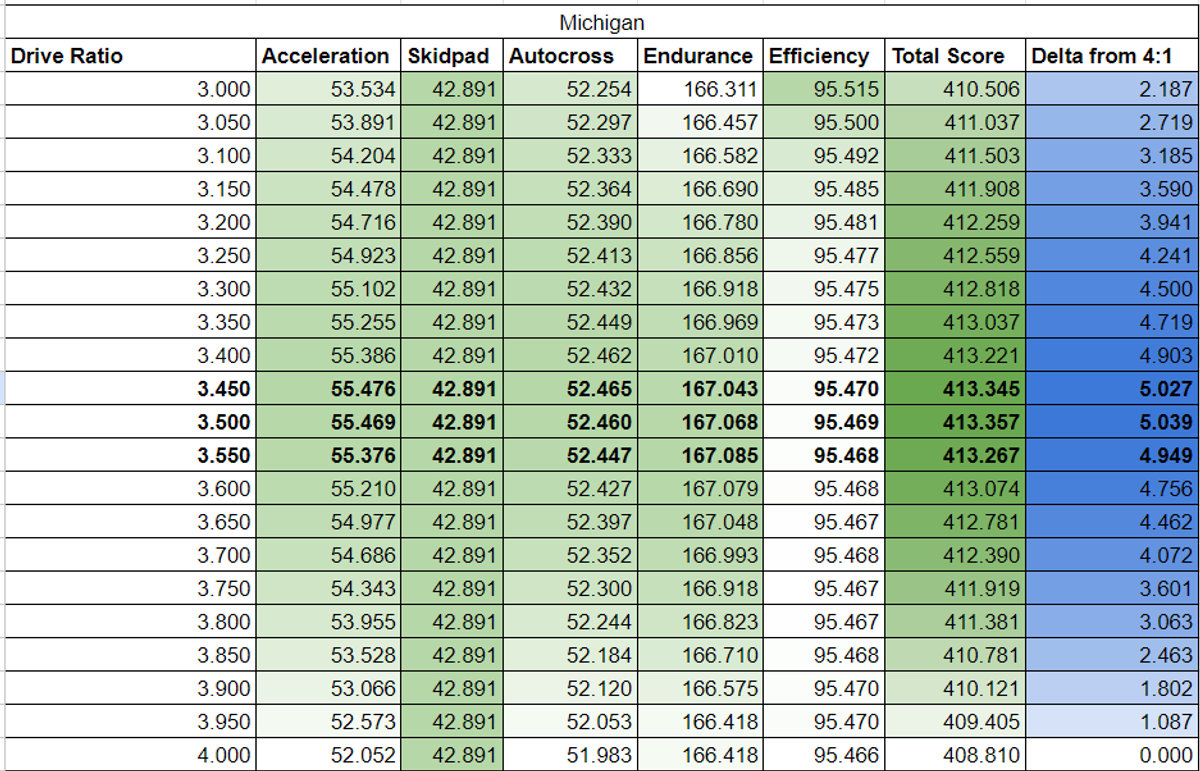
Points-based analysis comparing different drive ratios across multiple competition criteria

Autocross simulation validation showing correlation between predicted and actual lap times

Endurance event simulation validation demonstrating a correlation between simulation data and real life data
Impact & Results
This simulation-driven approach established new standards for our team's performance optimization:
- Reduced lap times by 1 second through optimized gear selection
- Improved acceleration performance in competition sprints
- Established data-driven methodology for future vehicle development
- Created reusable track models for ongoing simulation work
Next Development: This work laid the foundation for advanced MATLAB lap simulation development, addressing OptimumLap's limitations through custom open-source modeling.
Related FSAE Projects

MATLAB Lap Simulation Development
2024Led the transition from commercial OptimumLap software to custom MATLAB lapsim framework, collaborating with suspension team to implement TTC tire models and establishing foundation for advanced vehicle dynamics simulation.
Impact: Established foundation for advanced simulation with 5% accuracy improvement through TTC tire model integration and custom MATLAB framework development
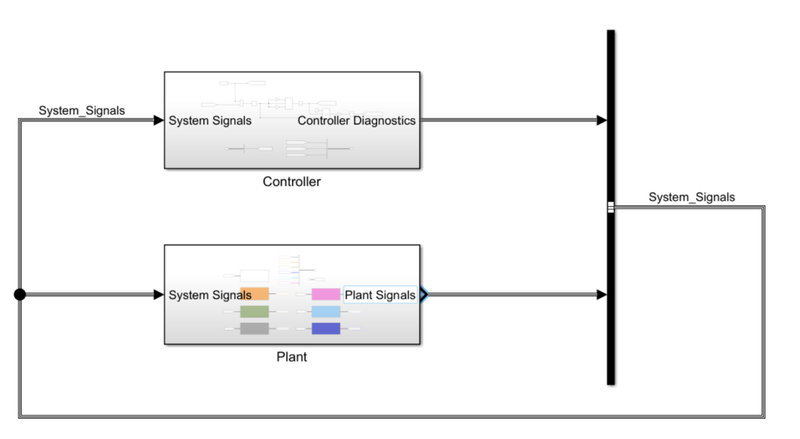
Integrated MATLAB Simulink Lap Simulation
2025Led development of integrated MATLAB Simulink framework advancing from steady-state to transient simulations, collaborating with powertrain and vehicle dynamics teams to integrate existing models and implement comprehensive multi-physics modeling with Vi-grade and Adams integration.
Impact: Established transient simulation capabilities enabling real-time analysis of complex vehicle dynamics, electrical systems, and thermal management interactions

2024 Cooling System Design & Thermal Optimization
2024Advanced thermal management optimization using CFD analysis and experimental validation, building on the 2023 foundation with significantly improved routing and component placement to achieve 10% cooling efficiency improvement and 5°C temperature reduction.
Impact: Achieved 10% cooling efficiency improvement and 5°C motor temperature reduction through CFD-driven design optimization